
Prode Properties
Properties of pure fluids and mixtures, multi phase equilibria, process simulation, software
Title : fluid properties and process simulation software, Windows, Linux, Android, IOS



Contact Prode
The thermodynamic properties which you need
When introduced in 1993 Prode Properties was the first
c++ thermodynamic framework designed to provide advanced features as those
available in process simulators within common Windows applications such as
Lotus 1,2,3 and Microsoft Excel, now (2022) it is a mature and stable
code which has been verified by Prode and many other companies with extensive testing for more than 25 years of service, Prode Properties provides a stable platform for both everyday work
and industrial applications.
Prode Properties permits to
calculate the properties of pure fluids or mixtures, solve two phase
(vapor-liquid) three phases (vapor-liquid-liquid) and
multiphase (vapor-liquid-solid-hydrate) separations, solves distillation columns, multiphase flow, prints phase envelopes , phase
diagrams, calculate critical points, cricondentherm, cricondenbar, heating / cooling curves etc.
Prode Properties represents the best solution when a compact and easy to use library for rigorous thermodynamics
is preferable over more complex tools.
Some applications:
- Direct integration with Excel, Open Office, Mathcad etc. for process simulation with rigorous thermodynamics
- DCS connection for realtime control and optimization
- Hydrocarbons dew point (HDP, HCDP), cricondentherm, cricondenbar of natural gas mixtures from gas analysis
- Thermodynamic properties, physical, thermophysical properties of pure fluids and mixtures,
- Natural gas : hydrate formation temperature and hydrate formation pressure, software for realtime applications.
- Gas/vapor-liquid, liquid-liquid, liquid-solid, phase separations
- Distillation columns
- Phase diagram and phase envelope
- Areas of application: petroleum, refining, natural gas, hydrocarbon, chemical, petrochemical, pharmaceutical, air conditioning, energy, mechanical industries
Perfect integration with your favourite software
Prode Properties links directly (you DO NOT need to run and connect two independent applications) with Microsoft Windows, Linux, Android applications including:
- Microsoft Excel
- Python
- Open Office (LibreOffice etc.
- Compilers C, VB, VBA, NET, FORTRAN, JAVA
- ...
Technical features overview
Prode Properties library includes C++ ANSI ISO standard code, there are no limits on number of concurrent threads, the version for Windows (the same code is available for Android, Linux etc.) is released in form of compact Dynamic Library.
- Support for Windows, Linux, Android applications
- Allows up to 100 different streams with up to 100 components per stream (user can redefine)
- Several compilations of chemical data and BIPs are available, the user can add new components and BIPs
- Comprehensive set of thermodynamic models
- Complete set of flash operations T-P, H-P, H-T, S-P, S-T, V-P, V-T, H-V, S-V, H-S, constant energy, phase-fraction...
- Functions for calculating specific properties of mixtures (critical point, Cricodentherm, Cricondenbar, cloud point etc.)
- Functions for calculating values and derivatives of fugacities, enthalpy, entropy, volume vs. temperature, pressure, composition
- Functions for calculating equilibrium lines at specified phase fractions (generation of phase diagrams)
- Functions for solving operating blocks as mixer, gas separator, liquid separator, distillation column, compressor, piping
- Functions for calculating stream properties as density, conductivity, viscosity (gaseous and liquid phases) surface tension, speed of sound, Joule Thomson etc.
Server Side (Linux server) online application examples
Prode Properties can be installed on servers (Linux, Windows), herebelow a few examples :
- Phase envelopes / diagrams
- Compare phase envelopes / diagrams with different models
- Hydrate formation
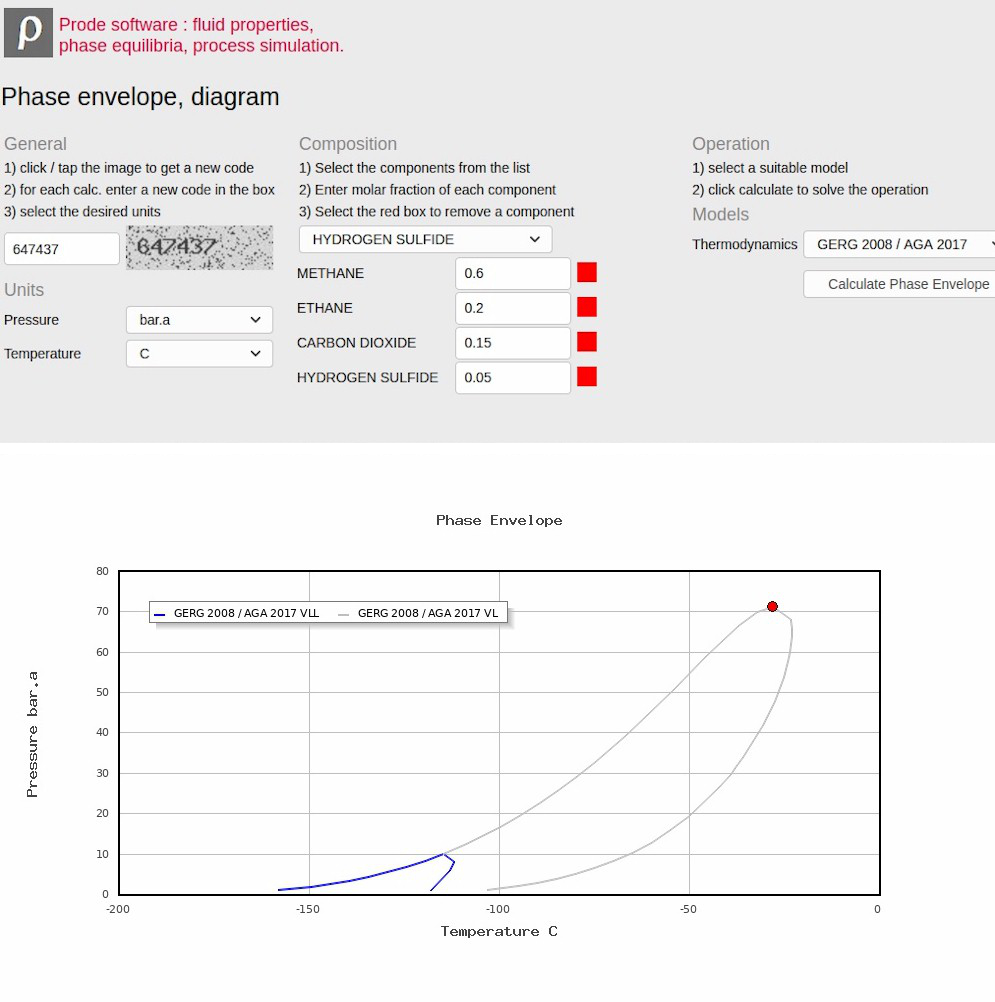
Desktop Applications (Client side) with Prode Editor edit streams, solve unit operations, edit the values in databases, the configuration settings, calculate BIPS (data regression procedure included) etc.
Prode Properties includes a editor which permits to define all the information ( composition, operating conditions, models, options) in all streams, solve unit operations, inspect the databases which contain the parameters for the different chemicals, calculate BIPS (with the included data regression procedure) etc.
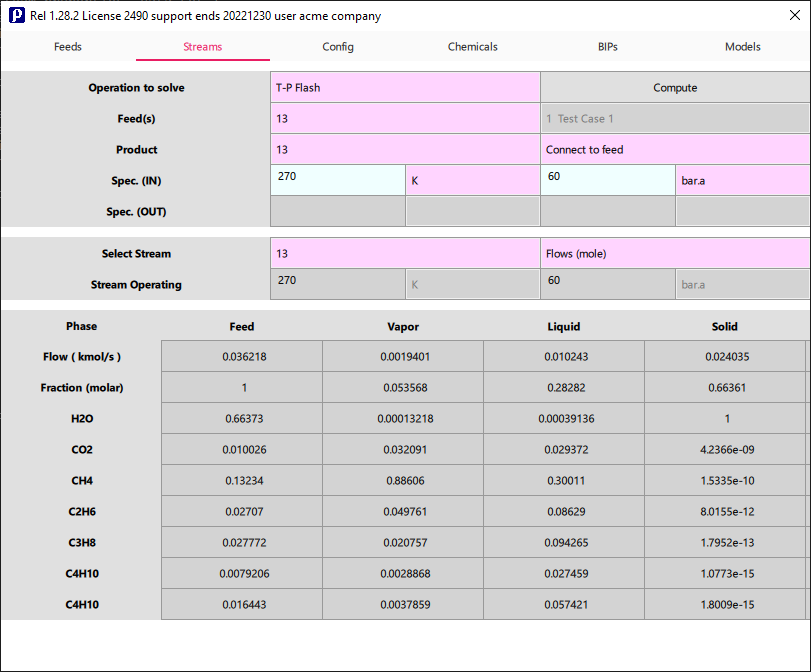
Local (desktop) Microsoft Excel, OpenOffice, Python, Mathcad applications in Windows
The distribution files include several applications examples for Excel, OpenOffice, Python and other tools, herebelow an application example showing Prode Properties solving a distillation column in Excel
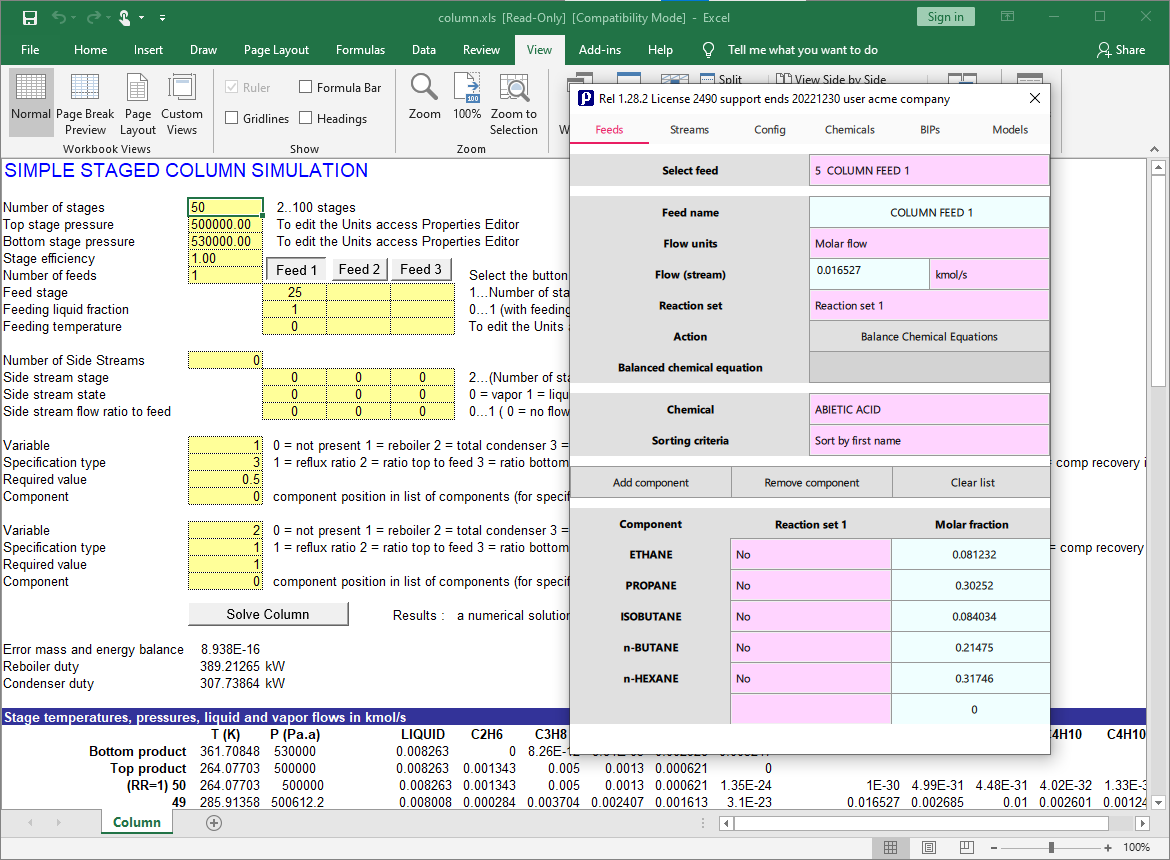
Fluid Properties in OpenOffice
The distribution files include several examples for OpenOffice, these examples are based on Open Office Basic interface (see the notes on operating manual), a different interface (based on UNO) is available from Prode
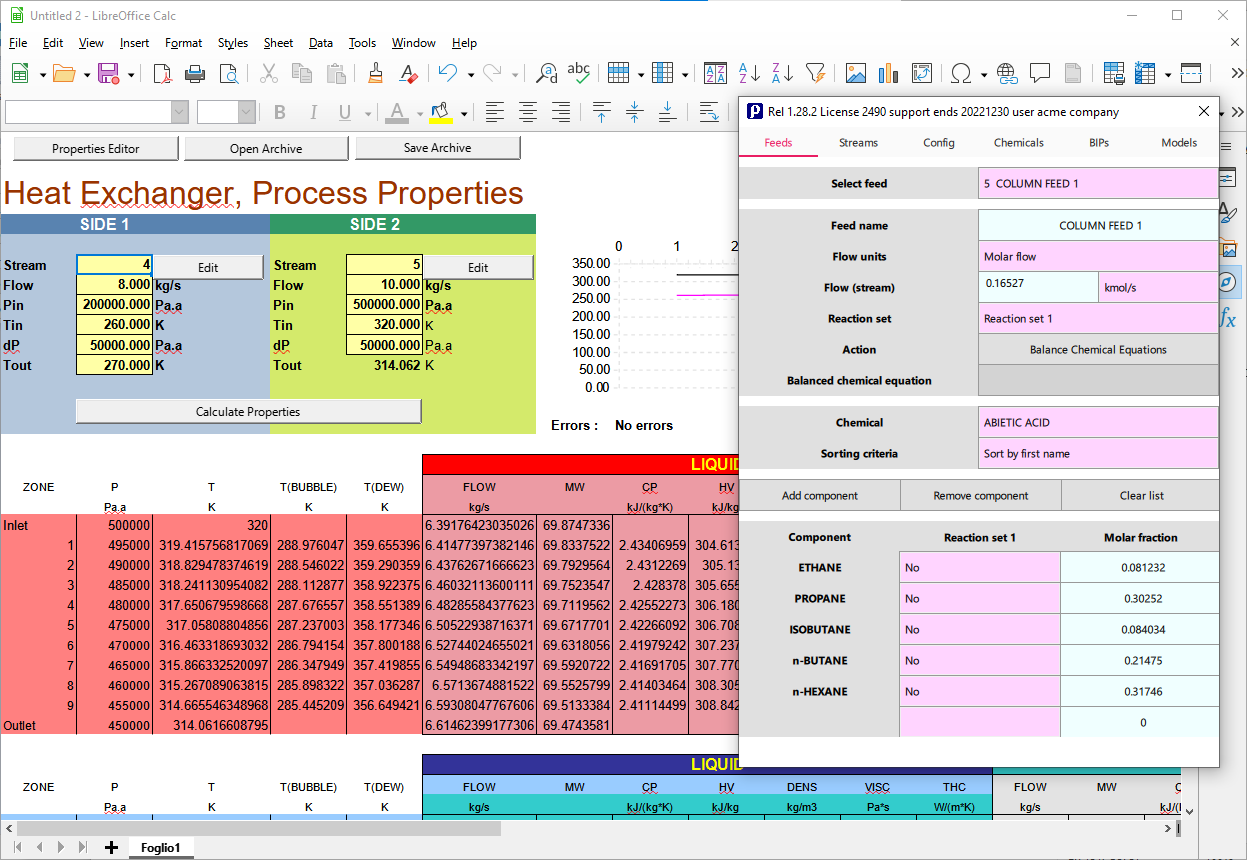
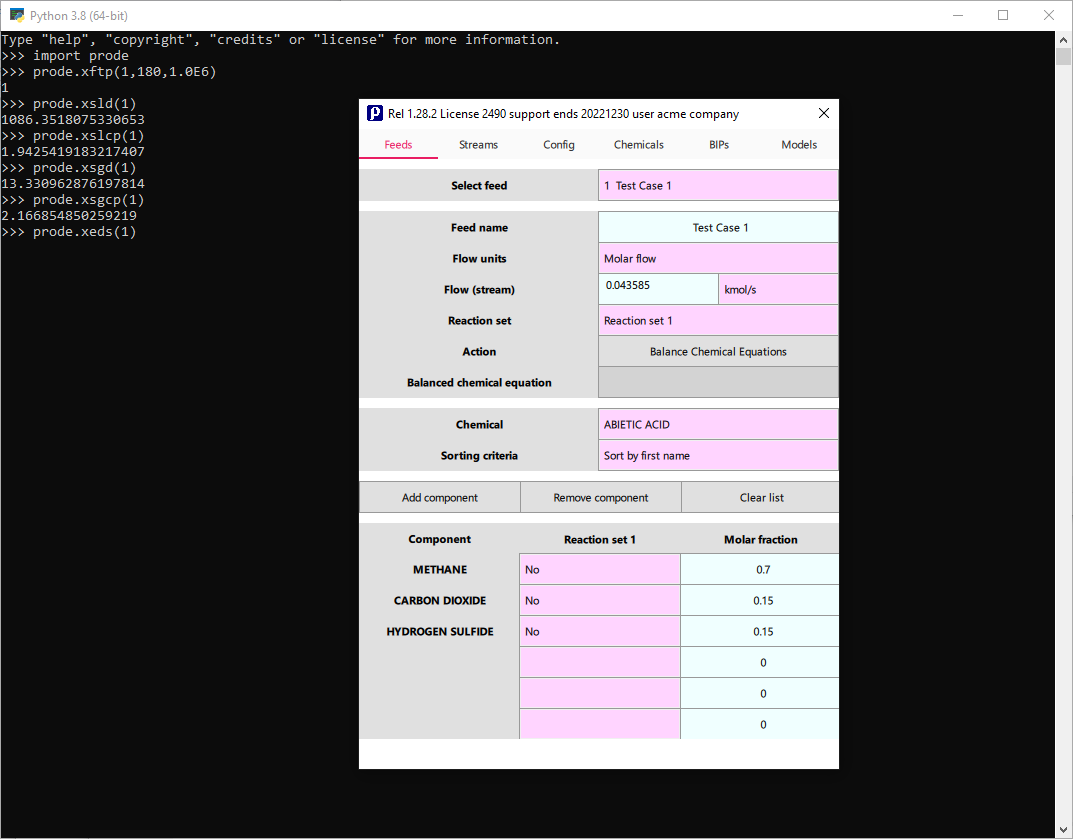
Fluid Properties in Python
Prode Properties provides a complete set of methods for calculating fluid properties and do process simulation in Python, this example shows how to obtain fluid properties in Python terminal
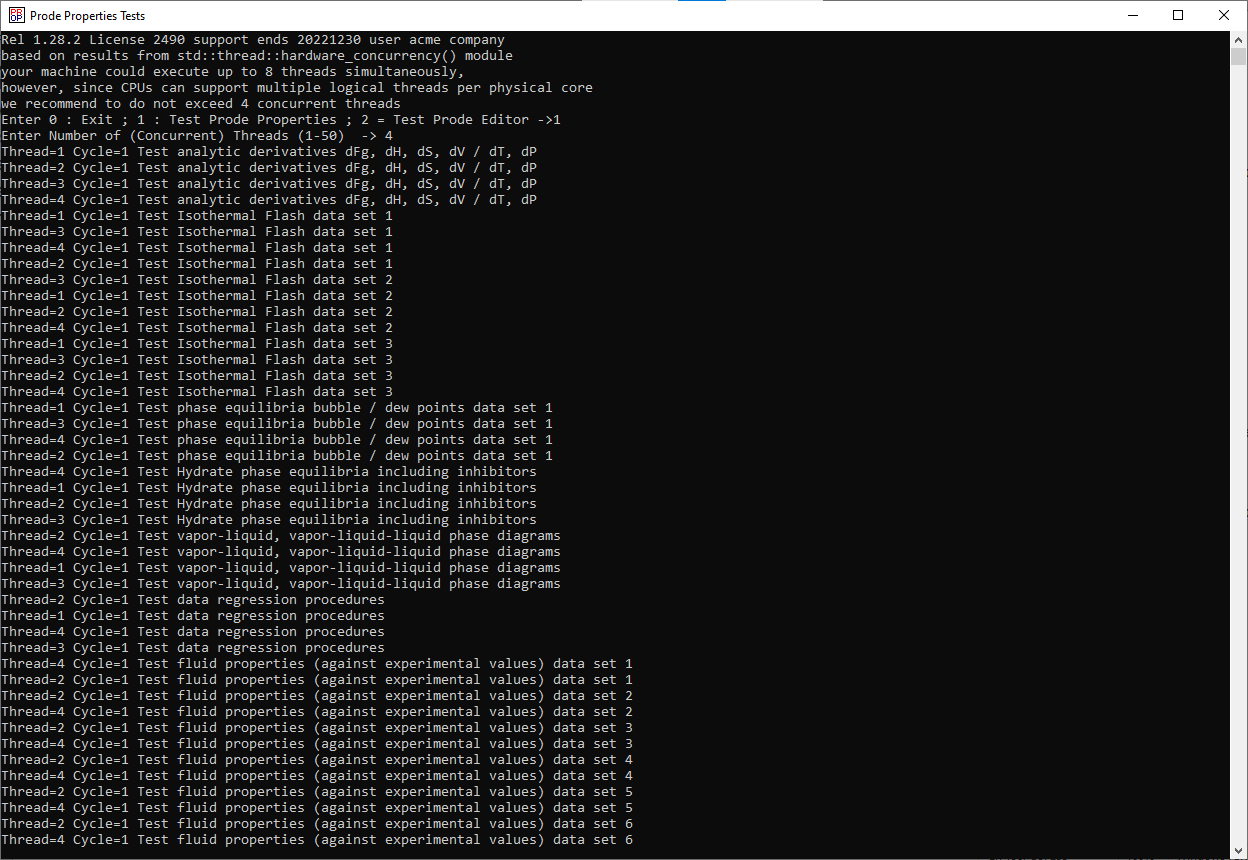
Run multiple threads with Prode Properties
Prode Properties supports multithreading by design, there are no limits on number of threads, the distribution includes a desktop app (Prode Properties Tests) which allows to test the software running multiple threads
Herebelow a short list of the properties available, read the operating manual for additional information.
- Phase fraction (vapor, liquid, solid -pure solids, solid mixtures, hydrate, asphaltene-)
- (True) critical point pressure of mixtures
- (True) critical point temperature of mixtures
- Cricondentherm temperature of mixtures
- Cricondentherm pressure of mixtures
- CricondenBar temperature of mixtures
- CricondenBar pressure of mixtures
- Cloud point temperature of mixtures
- Cloud point pressure of mixtures
- Flash point of flammable mixtures
- Enthalpy of gas / vapor phase
- Enthalpy of liquid phase
- Enthalpy of solid phase
- Entropy of gas / vapor phase
- Entropy of liquid phase
- Entropy of solid phase
- Density of gas / vapor phase
- Density of liquid phase
- Density of solid phase
- Isobaric specific heat (Cp) of gas / vapor phase
- Isobaric specific heat (Cp) of liquid phase
- Isochoric specific heat (Cv) of gas / vapor phase
- Isochoric specific heat (Cv) of liquid phase
- Gas heating value
- Gas Specific gravity
- Joule Thomson coefficients of gas / vapor phase
- Joule Thomson coefficients of liquid phase
- Isothermal compressibility of gas / vapor phase
- Isothermal compressibility of liquid phase
- Volumetric expansivity of gas / vapor phase
- Volumetric expansivity of liquid phase
- Speed of sound in gas / vapor phase
- Speed of sound in liquid phase
- Speed of sound in gas+liquid (mixed) phase
- Viscosity of gas / vapor phase
- Viscosity of liquid phase
- Thermal conductivity of gas / vapor phase
- Thermal conductivity of liquid phase
- liquid Surface tension
Technical features overview (Windows version)
- Entirely written in C++ (since first edition, 1993)
- Up to 100 different streams with up to 50 components per stream (user can redefine)
- Several compilations of chemical data and BIPs are available, the user can add new components and BIPs
- Proprietary compilation with data for more than 1600 chemicals and 30000 BIPs
- flexible database format (support for up to 30 different correlations) works with all majour standards including DIPPR.
- Comprehensive set of thermodynamic models (see below the table) with standard and extended versions with parameters calculated to fit experimental data from DIPPR and DDB
- Selectable units of measurement
- Procedure for solving fluid flow including multi phase equilibria and heat transfer
- Procedure for solving staged columns
- Rigorous solution of distillation columns, fractionations, absorbers, strippers...
- Procedure for calculating hydrate formation temperature and hydrate formation pressure
- hydrate phase equilibria based on different Van Der Waals-Platteeuw models
- Procedure for solving polytropic compression with phase equilibria
- Huntington method for gas phase
- Proprietary method for solving a polytropic process with phase equilibria
- Procedure for solving isentropic nozzle (safety, relief valve with single and two phase flow)
- HEM, Homogeneous Equilibrium
- HNE-DS, Homogeneous Non-equilibrium
- NHNE, Non-homogeneous Non-equilibrium
- Procedure for simulating fluid flow in piping (pipelines) with heat transfer
- Beggs and Brill and proprietary methods for single phase and multiphase fluid flow with heat transfer
- Procedure for fitting BIP to measured VLE / LLE / SLE data points (data regression)
- Procedure for fitting BIP to VLE values calculated with UNIFAC
- Functions for simulating operating blocks (mixer, gas separator, liquid separator) **
- Functions for accessing component data in database (the user can define mixing rules)
- gas / vapor-liquid-solid fugacity plus derivatives vs. temperature pressure composition
- gas / vapor-liquid-solid enthalpy plus derivatives vs. temperature pressure composition
- gas / vapor-liquid-solid entropy plus derivatives vs. temperature pressure composition
- gas / vapor-liquid-solid molar volume plus derivatives vs. temperature pressure composition
- Flash at Bubble and Dew point specifications and P (or T)
- Flash at given temperature (T) and pressure (P) multiphase vapor-liquid-solid, isothermal flash
- Flash at given phase fraction and P (or T), solves up to 5 different points
- Flash at given enthalpy (H) and P multiphase vapor-liquid-solid, includes adiabatic flash
- Flash at given enthalpy (H) and T multiphase vapor-liquid-solid, includes adiabatic flash
- Flash at given entropy (S) and P multiphase vapor-liquid-solid, includes isentropic flash
- Flash at given entropy (S) and T multiphase vapor-liquid-solid, includes isentropic flash
- Flash at given volume (V) and P multiphase vapor-liquid-solid, includes isochoric flash
- Flash at given volume (V) and T multiphase vapor-liquid-solid, includes isochoric flash
- Flash at given volume (V) and enthalpy (H) multiphase vapor-liquid-solid
- Flash at given volume (V) and entropy (S) multiphase vapor-liquid-solid
- Flash at given enthalpy (H) and entropy (S) multiphase vapor-liquid-solid
- Rigorous (True) critical point plus Cricondentherm and Cricondenbar
- Complete set of properties for different states
- gas density
- vapor density
- liquid density
- solid density
- gas Isobaric specific heat (Cp)
- vapor Isobaric specific heat (Cp)
- liquid Isobaric specific heat (Cp)
- gas Isochoric specific heat (Cv)
- vapor Isochoric specific heat (Cv)
- liquid Isochoric specific heat (Cv)
- gas cp/cv
- liquid cp/cv
- Gas heating value
- Gas Wobbe index
- Gas Specific gravity
- gas Joule Thomson coefficients
- vapor Joule Thomson coefficients
- liquid Joule Thomson coefficients
- gas Isothermal compressibility
- vapor Isothermal compressibility
- liquid Isothermal compressibility
- gas Volumetric expansivity
- vapor Volumetric expansivity
- liquid Volumetric expansivity
- gas Speed of sound
- vapor Speed of sound
- liquid Speed of sound
- vapor + liquid (HEM) Speed of sound
- gas Viscosity
- vapor Viscosity
- liquid Viscosity
- gas Thermal conductivity
- vapor Thermal conductivity
- liquid Thermal conductivity
- gas compressibility factor
- vapor compressibility factor
- liquid Surface tension
Thermodynamic models available (version 1.25 May 2020), the list may change depending from version
- Code: 1 Model: Regular | Identifier : Regular
- Code: 10 Model: Wilson | Identifier : Wilson
- Code: 11 Model: NRTL | Identifier : NRTL
- Code: 12 Model: UNIQUAC | Identifier : UNIQUAC
- Code: 30 Model: Soave-Redlich_Kwong Std. (VDW) | Identifier : SRK(VDW)
- Code: 31 Model: Soave-Redlich_Kwong Ext. (VDW) | Identifier : SRKX(VDW)
- Code: 40 Model: Soave-Redlich_Kwong Ext. + NRTL (Modified Huron Vidal) | Identifier : SRKX-NRTL(P-HV)
- Code: 41 Model: Soave-Redlich_Kwong Ext. + NRTL (Modified LCVM) | Identifier : SRKX-NRTL(P-LCVM)
- Code: 50 Model: Peng Robinson Std. (VDW) | Identifier : PR(VDW)
- Code: 51 Model: Peng Robinson Ext. (VDW) | Identifier : PRX(VDW)
- Code: 55 Model: Peng Robinson Ext. + Wilson (Wong Sandler) | Identifier : PRX-Wilson(WS)
- Code: 56 Model: Peng Robinson Ext. + UNIQUAC (Wong Sandler) | Identifier : PRX-UNIQUAC(WS)
- Code: 57 Model: Peng Robinson Ext. + NRTL (Wong Sandler) | Identifier : PRX-NRTL(WS)
- Code: 60 Model: Peng Robinson Ext. + NRTL (Modified Huron Vidal) | Identifier : PRX-NRTL(P-HV)
- Code: 61 Model: Peng Robinson Ext. + Wilson (Modified Huron Vidal) | Identifier : PRX-Wilson(P-HV)
- Code: 62 Model: Peng Robinson Ext. + UNIQUAC (Modified Huron Vidal) | Identifier : PRX-UNIQUAC(P-HV)
- Code: 65 Model: Peng Robinson Ext. + Wilson (MHV2) | Identifier : PRX-Wilson(MHV2)
- Code: 66 Model: Peng Robinson Ext. + UNIQUAC (MHV2) | Identifier : PRX-UNIQUAC(MHV2)
- Code: 67 Model: Peng Robinson Ext. + NRTL (MHV2) | Identifier : PRX-NRTL(MHV2)
- Code: 70 Model: Peng Robinson Ext. + NRTL (Modified LCVM) | Identifier : PRX-NRTL(P-LCVM)
- Code: 71 Model: Peng Robinson Ext. + Wilson (Modified LCVM) | Identifier : PRX-Wilson(P-LCVM)
- Code: 72 Model: Peng Robinson Ext. + UNIQUAC (Modified LCVM) | Identifier : PRX-UNIQUAC(P-LCVM)
- Code: 73 Model: Peng Robinson Ext. + UNIFAC (Modified LCVM) | Identifier : PRX-UNIFAC(WS)
- Code: 80 Model: Benedict-Webb-Rubin (modified) | Identifier : BWR
- Code: 81 Model: Benedict-Webb-Rubin-Starling | Identifier : BWRS
- Code: 90 Model: Lee Kesler | Identifier : LK
- Code: 91 Model: Lee Kesler Ploecker | Identifier : LKP
- Code: 100 Model: P-SAFT | Identifier : PSAFT
- Code: 110 Model: Soave-Redlich_Kwong Ext. - CPA | Identifier : SRKX-CPA(VDW)
- Code: 111 Model: Peng Robinson Ext. - CPA | Identifier : PRX-CPA(VDW)
- Code: 115 Model: Peng Robinson Ext. - CPA + NRTL (Modified Huron Vidal) | Identifier : PRXCPA-NRTL(P-HV)
- Code: 116 Model: Peng Robinson Ext. - CPA + NRTL (Modified LCVM) | Identifier : PRXCPA-NRTL(P-LCVM)
- Code: 117 Model: Peng Robinson Ext. - CPA + NRTL (Modified MHV2) | Identifier : PRXCPA-NRTL(P-MHV2)
- Code: 118 Model: Peng Robinson Ext. - CPA + NRTL (Modified Wong Sandler) | Identifier : PRXCPA-NRTL(P-WS)
- Code: 120 Model: Soave-Redlich_Kwong Ext. - CPA + NRTL (Modified Huron Vidal) | Identifier : SRKX-CPA-NRTL(P-HV)
- Code: 130 Model: UNIFAC UNIFAC 150 Solid Pure (derived from) PRX-NRTL(P-HV) | Identifier : SPRX-NRTL(P-HV)
- Code: 151 Model: Solid Pure (derived from) PRXCPA-NRTL(P-HV) | Identifier : SPRXCPA-NRTL(P-HV)
- Code: 153 Model: Solid Solution (derived from) PRX-NRTL(P-HV) | Identifier : SSPRX-NRTL(P-HV)
- Code: 170 Model: Hydrate (derived from) PRXCPA-NRTL(P-HV) | Identifier : HPRXCPA-NRTL(P-HV)
- Code: 171 Model: Hydrate (derived from) PRX-NRTL(P-HV) | Identifier : HPRX-NRTL(P-HV)
- Code: 180 Model: Wax Wax 185 Asphaltene | Identifier : Asphaltene
- Code: 200 Model: Pitzer (Electrolyte) | Identifier : PITZER
- Code: 205 Model: Peng Robinson Ext. -CPA-(MSA) + NRTL (Modified Huron Vidal) Electr. | Identifier : PRXCPA-E-NRTL(P-HV)
- Code: 210 Model: P-SAFT-(MSA) Electrolyte PSAFT-E
- Code: 300 Model: Steam tables based on IAPWS 1995 formulation | Identifier : IAPWS 95
- Code: 311 Model: GERG 2008 | Identifier : GERG 2008
- Code: 312 Model: ISO 18453 (GERG) | Identifier : ISO 18453
- Code: 315 Model: ISO 20765 (AGA 8) | Identifier : ISO 20765
Typical applications
- Fluid Properties
- Process simulation
- Heat / Material Balance
- Process Control
- Process Optimization
- Equipments Design
- Separations
- Instruments Design
- Realtime applications
- petroleum refining, natural gas, hydrocarbon, chemical, petrochemical, pharmaceutical, air conditioning, energy, mechanical industry